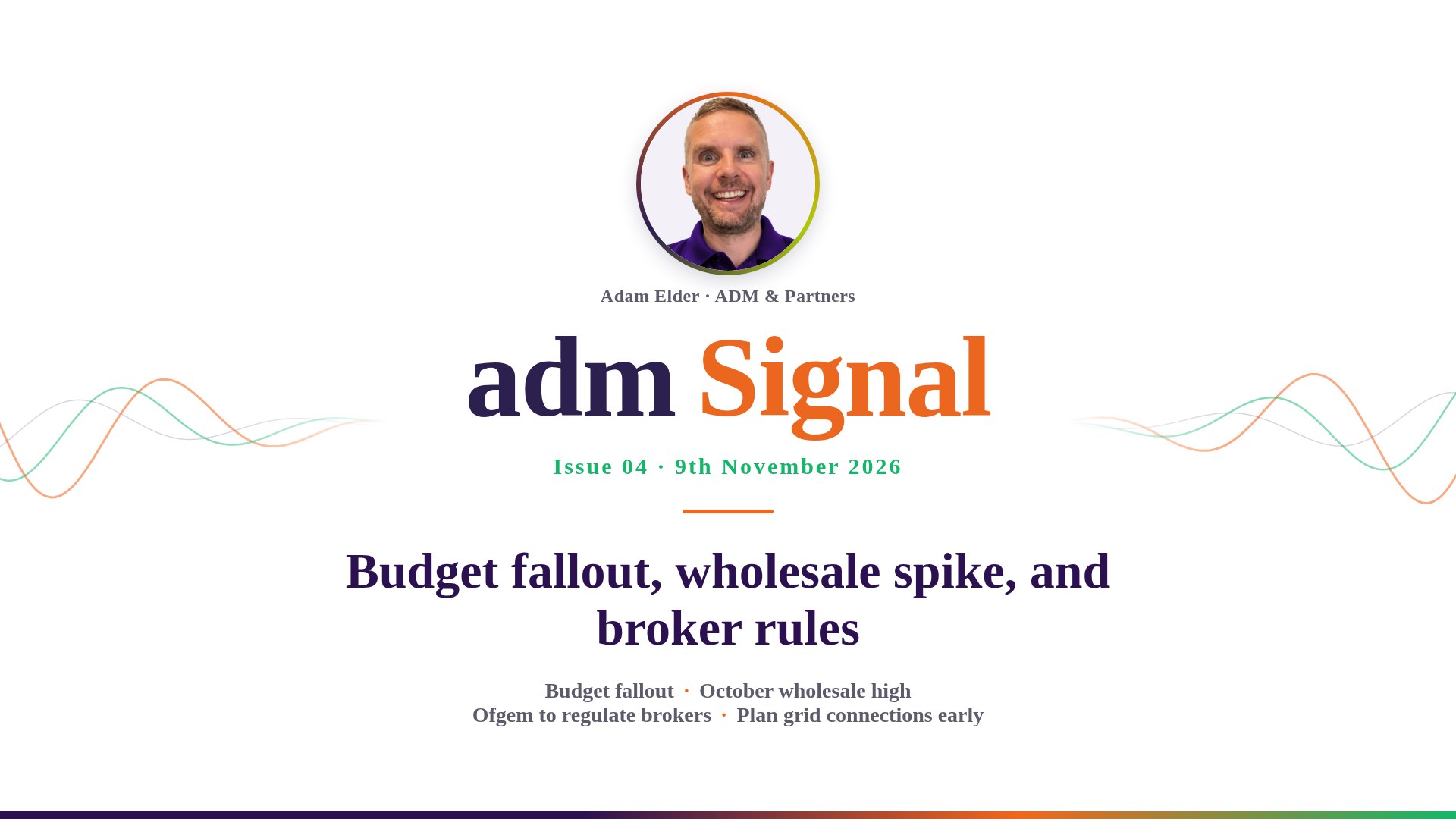
Welcome to Issue 04 of adm Signal.
Sixty seconds. What's moving on energy and the cost of running a site over the next fortnight, without the sales pitch.
1. The Budget landed: help for manufacturers, little for everyone else this winter
The Chancellor delivered the Autumn Budget on Wednesday 28th October. The main business energy measure is still the British Industrial Competitiveness Scheme: from April 2027 it aims to cut electricity costs for over 10,000 eligible manufacturers by up to 25%. Climate Change Levy rates on electricity will be frozen from 1st April 2028, with gas still rising with inflation. The government also said no further policy costs will be added to bills until a new cost-control framework arrives with the Spending Review in 2027.
There was no immediate cut to business energy bills this winter. Business contracts still have no price cap. Cornwall Insight called it a clear shift towards affordability as the first test of energy policy, but said the household measures will take time to show up in bills.
Find out more: What the Budget means for business energy · GOV.UK Budget 2026 · Cornwall Insight on the Budget
2. Wholesale prices ended October at their highest this year
If your gas or electricity contract renews this winter or during 2027, October matters. According to Catalyst Commercial's market report of 2nd November 2026, wholesale gas for this winter rose by almost 40% during October, and winter electricity by about a third. Prices jumped again on Friday 30th October and closed the month at their highest levels of the year. At that close, winter wholesale gas was around 8.8p per kWh and electricity around 20p per kWh — before network costs, levies and the supplier's margin. Electricity for January to March 2027 closed above £200 per MWh for the first time.
As Cornwall Insight has pointed out, businesses that fix prices months ahead aren't hit straight away by a short spike, but the longer high prices last, the more businesses feel them. Don't panic-buy on a bad day. Agree a target price, or spread buying over several dates, and check which parts of your "fixed" contract still move.
Find out more: What October's wholesale rise means for renewals · Catalyst Commercial, 2nd November 2026 · Cornwall Insight on business bills
3. Energy brokers are set to be regulated by Ofgem
On 4th November the government introduced the Energy Independence Bill. Unlike mortgage or insurance advisers, energy brokers and other middlemen have been largely unregulated. The Bill will give Ofgem powers to order compensation, impose fines and ban rogue operators. The government's earlier response on third-party intermediaries already set out the plan: Ofgem becomes the regulator for energy procurement intermediaries; firms will have to register, including "fit and proper" checks on decision makers; and after a 12 to 18 month sunrise period it becomes illegal to arrange energy contracts without Ofgem authorisation.
Ofgem has already started a market review. Its concerns include mis-selling, pressure selling, low transparency and incentives that don't always serve the customer. Nothing changes overnight — but before you sign your next contract, ask how the person advising you is paid, how many suppliers they compared, and whether the end date, notice period and price match what you were told.
Find out more: What broker regulation means for your business · The Guardian, 4th November 2026 · GOV.UK TPI response · Ofgem on intermediaries
4. Planning a bigger grid connection? Start the conversation early
On 28th October the government confirmed how it will manage the queue for new and bigger electricity connections. Strategically important projects — including data centres and some large industrial sites — can be moved nearer the front of the queue, and capacity freed when stalled projects drop out can be handed to those priority projects. Most businesses connect through their local network operator, so you're unlikely to be directly reordered. But it's a clear sign of how tight grid capacity has become. In March the government said demand for these connections had grown by 460% in six months, with some projects facing waits of up to 15 years.
If growth or electrification is in your three-to-five-year plan, ask your local network operator early what capacity your site has, and what an upgrade might cost and how long it would take. On-site options — solar, a battery, or shifting some use away from the busiest times — can reduce how much extra grid capacity you need.
Find out more: Why it pays to plan grid connections early · GOV.UK government response
And finally, time is running out on BICS: applications close at 11:59pm on 30th November. Our BICS guide
Key dates
📅 13th November 2026: Ofgem consultation on self-build of transmission connections closes 📅 25th November 2026: Ofgem's January household price cap announced (by this date) 📅 30th November 2026, 11:59pm: BICS applications close 📅 5th December 2026: ESOS Phase 3 progress update (if you qualify) 📅 11th December 2026: Ofgem DCP 412 consultation closes 📅 1st January 2027: UK CBAM starts; suppliers start writing to business customers about the smart meter rule 📅 1st April 2027: BICS RO and FiT exemptions start 📅 1st September 2027: smart or advanced meter needed for new fixed-term business contracts
What to do this fortnight
If your energy contract renews in the next year, ask whoever advises you, in writing, how they are paid and how much commission is built into your price. Then decide whether to fix on one date or spread your buying over several.
Adam
- adm Signal
- Budget
- Wholesale
- Brokers
- Grid connections
- BICS
Want to know what this means for your business?
Book a free energy review